Calculate Your Savings
HERE
Boxes Created 1600000000
90000000 CO₂ Saved (lbs)
4518639.77 Trees Saved



In the current technological landscape, all roads seem to lead to AI. But is artificial intelligence really the answer to streamlining and alleviating your workload?
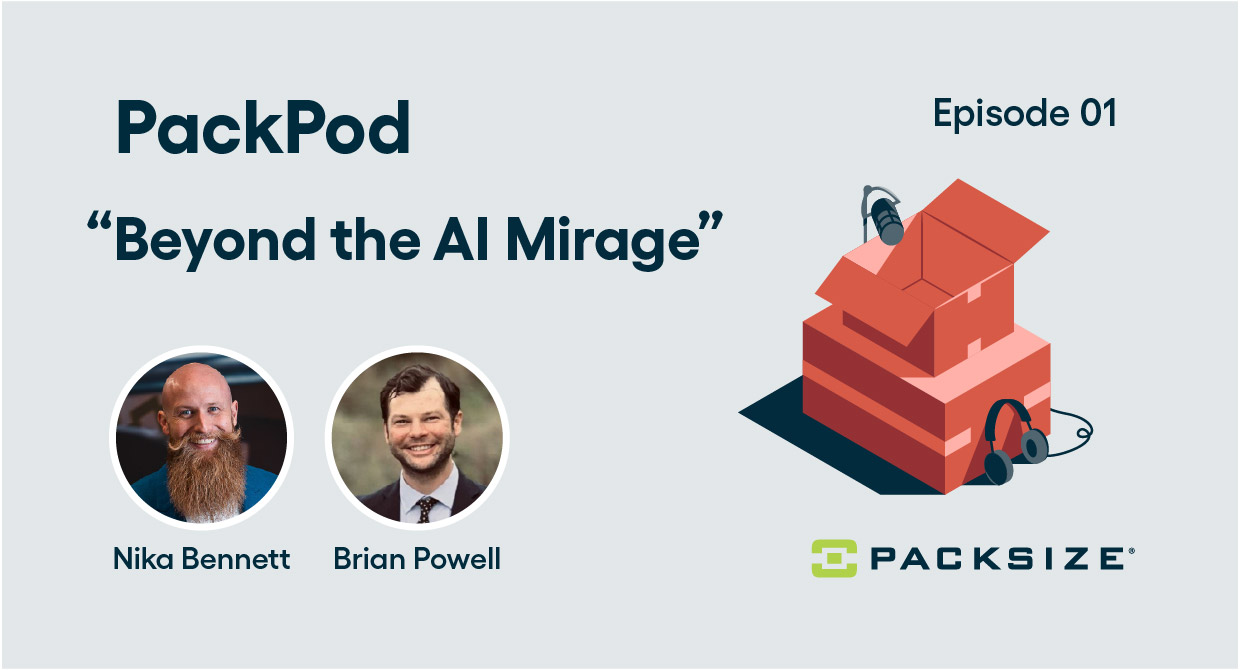
Join Nika Bennett, Global Director of Channel Operations, and Brian Powell, Software Solutions Engineer, for a conversation about how AI is popping up in the Packaging and Distribution industry – and whether it should be utilized at all.
Learn about what will actually make a difference in the warehouse space to move your operation forward, and how a people-centered approach often achieves the best results.
In this episode of PackPod, Nika and Brian will ask you to look beyond the AI mirage to discover what is really holding your business back from a streamlined and efficient packaging process flow.
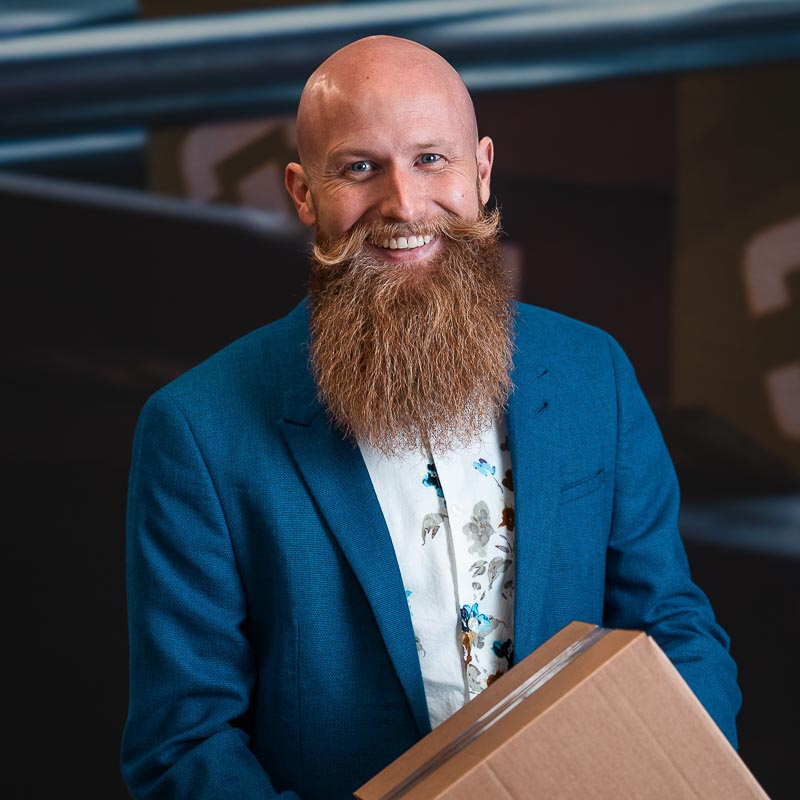
Nika Bennett: Thank you and welcome. My name is Nika Bennett. I'm the Director of Channel Operations for our global sales force here at Packsize. Excited to be with you. I'm joined by Brian.
Brian Powell: Hello. Nice to meet you guys. I'm Brian Powell. I'm a Software Solutions Engineer here at Packsize. I work on the integration side of things for both existing customers and implementing new technologies, but also planning out fresh solutions for some of our new prospective customers. Good to be here with you, Nika.
Nika Bennett: Perfect. Let's get right into it. I think there's a very important topic today, and I want to start with something that most companies don't want to admit. Right now, there's a lot of hype around this, but waiting for this promised AI moment to magically arrive might be the single most expensive decision you can make. Because while everyone else is chasing hype, the real opportunity is in the work your people are grinding through right now.
The conversation we're about to have isn't about AI as a buzzword. It's going to be about people, flow, friction, misdiagnosis, and -- most importantly what we want to tackle is decision clarity. It's the things that actually move your operation forward. If you work in a warehouse or fulfillment or even another aspect of the business, you already know the real pain points. It's extensive ways, problematic equipment, and a million other things that Brian sees every single day.
Brian Powell: AI cannot solve a lot of those problems, Nika. That's what you referred to in the real world when we're trying to improve customer operations at these centers and save money, increase efficiencies, and remove those pain points operationally for the workers at those centers. I fail to see how AI is going to drive a lot of those changes and a lot of that value.
Nika Bennett: You're telling me that AI won't fix fatigue, rework, and stress for your whole team?
Brian Powell: No. Right -sized packaging will, Nika. At the end of the day, that's what we're here to show the value for as a company.
Nika Bennett: We might be a little biased, but we'll get into it.
Yeah. I mean, I receive e-mails all day long just like everyone out there. Inbox says everything AI, all the time. Everything is AI powered. For us, it's AI labor optimization, picking logic, routing, AI-driven robots, intelligence around inventory, and all of that is really promising this transformation -- like Brian called out -- for a lot of things that aren't solvable with those products. Most of that's just going to deliver noise for you. This is where there's a massive psychological trap that begins when we talk again about decision clarity.
I want to frame it up this way. With every major business decision today and historically, we're always caught between two forces. So, the first one, of course, is the acronym FOMO, Fear of Missing Out. But there's a second component to that when we talk about decisions, and there's the reality. It's the Fear of Messing Up or FOMU. Sellers weaponize the Fear of Missing Out better than anybody else. That's how sales thrive, right? Everyone else is investing, you're missing out on AI, is your strategy aligned, and of course, you don't want to fall behind. But what's often overlooked is what buyers live with, and that's what if it fails? What if it breaks my operations? I heard something else about a failed deployment – am I going to make the wrong call and is it going to put my job in jeopardy? We still have people making decisions.
If you've ever lived through a failed tech rollout, or you've seen a transformational collapse with a massive decision that somebody made about purchasing a product and trying to implement it, we always see these pilots just burn out very, very quickly. Brian, is that something you see in that space?
Brian Powell: I just see your points about the Fear of Messing Up. Packsize, when we're trying to implement a solution on a customer site, our biggest competitor isn't competing technology, since we lead in the space and we dominate. It’s the status quo, and that dovetails with the Fear of Messing Up aspect of implementing a solution that Packsize offers. So that's our number one enemy is the status quo, so that's the Fear of Messing Up. So, at the end of the day, that's where we need to present our value -- where we drive savings across the board -- because it's more than just a box machine. We sell solutions and it affects almost every aspect of the operation center.
So, I can understand where customers have that Fear of Messing Up with the status quo, because it's easy to stick with what you have. We might not be promising a flashy, slap AI on one of our machines and call it whatever you want to call it, but at the end of the day, you're trying to save money, improve your operator's experience, and just have a better solution in place for your pack-out.
I think a big component of these customers we worked with, these systems, they'll nail all the pick stuff and they'll nail the visibility, and they will leverage those technologies when they have the data available, but what they don't have is the pack-out, the shipping, the ability to functionally transform that final last mile of their operations of getting a shipment out the door. Be it a manufacturing and they are making giant windows, giant custom this, and they need one of our machines that can accommodate that pack-out in an efficient manner where they're not cutting manual boxes or their process isn’t clean. Or maybe it's a more high automation distribution center, and they've got the picking nailed down, they've got all the other tech nailed down, but they're still going to a pack-out process. They still have manual boxes, it's still clunky -- it's almost like one of the primary bottlenecks for having a holistic streamlined overall operation.
So that's where it's not glamorous to talk about boxes all the time. I mean, we talk about boxes all day, every day, but you can't ship something without a box, and you need a right-sized box, and it's less about the boxes, it is the right solution. What our machines and our software and our technologies and our products offer -- it's more than just the box. It is the holistic solution and we have the flexibility to slot into all these environments from giant manufacturing to highly automated distribution. We're the linchpin of the last mile of packing stuff up. So, I'll quit rambling for a second, Nika.
Nika Bennett: I think you are spot on with a lot of that. I want to call back to when you talk about status quo being our largest competitor, and you talk into other things that people have solved for. I think when we think about status quo, a lot of the time, it's actually branded wrong, because why is it still status quo? Everyone agrees tape guns suck. Nobody's looking at their tape gun and saying, “It's my favorite thing that's ever existed, and it means so much to me.” No, go sit on the floor with an operator. It is infuriating. If you've ever packed anything at home, you know what we're talking about.
So really when we think of why are they sticking with status quo, a majority of the time -- more than half nonnegotiably -- it is that they're just not making a decision. That's a lot of the paralysis behind it, and that hesitation, that fear of change, really is impacted by what has happened in the past. So even if we talk about prioritizing, sortation, conveyance, whatever it may be -- any pain that they've felt from that past decision, even if automating the packaging, or right-sizing, or anything that we do and we see day in, day out -- those past decisions really come back to haunt their ability to execute and make a decision to land on something that will make that linchpin-type transition, and to be able to future-proof their organization.
And I mean, they're not wrong a lot of the time, especially in this AI hype era that we live in, because some of the stories you hear are just absurd in our space, right? There was a warehouse vision AI that was deployed to help classify inbound cartons, and it labeled a 35-pound kettle ball that was red as a tomato. And the facility had nothing to do with produce whatsoever, so as it tries to feed the data in the system, it's only junking it up, which causes so many headaches for other people. And that's what happens when you add intelligence on top of instability. So, if the foundation's wrong, then AI doesn't automate anything. It's just going to amplify confusion. And so that's where we hit the perfect point to stop and ask, “If AI is the future, then why are the biggest efficiency gains still coming from cardboard, like Brian called out?”
Brian Powell: Yeah, and we actually had a visitor in our demo center today. They were a very interesting company -- only about 200 employees in a niche market -- but it was family-owned, 200 employees. And the guests that came and visited were highly technical. They were the guys that run their systems, right? And they were telling us all about how world-class they are, all their metrics on their picking, all this visibility, all these other systems that they've built -- but they're using 40 stock boxes. And our business case is already probably going to be strong. They kind of had a little bit of understanding like, “Oh, we can have machines that can make any boxes.” They also have a mixed SKU, so they're going to be utilizing various designs, but you could see the wheels start turning and the main two people's heads that built out all of their existing systems. As soon as they saw the EM7 and the X5 making boxes, they asked some questions, they took a look at our software and all of the benefits and just how everything works, and the wheels started turning in their heads. They were already live solutioning how they're going to implement like, “Oh, well, wait, we have the data here and then we could do this.” And then, you just kind of see it in real time.
You wouldn't think that a machine that makes boxes would kind of inspire that level of brainstorming and thinking about like, “Hey, we need to change out our whole packing operation because we can get these things.” And that's the flexibility that we unlock as a company between our hardware and our software and our ability to integrate with these systems. That's why we say we have 4,000 custom solutions all over the world, right? It's because we fit into all of these specific use cases and we have that flexibility to integrate into whatever's needed for an efficient, productive, and cost savings way to handle your shipping. And so, that's always fun to see. That's one of the best parts about having visitors come look at the machines and have the Q&A is that the wheels start turning in their heads and then they start asking more questions. And then next thing you know, they're like, “Okay, when can I get these machines,” right? So, I got to experience that firsthand today, just add it to the pile.
But that's the sort of thing that our machines unlock, and it doesn't have to be -- since we have such a wide variety of machine platforms and technologies is that we span across every vertical. Everything's going to go in a box, everything's going to get shipped, and that really just allows whoever to kind of grow with us to implement. You know, if they just get a machine and the first thing we do, right? We're going to get a machine, we're going to replicate our stock boxes, we're going to have corrugate savings. Okay, we're going to be able to make our boxes, keep everything the same as it is today, because we don't want to mess up, we don't want to have big change. Okay, but we can save money on just the cardboard and just the boxes. And that's usually the starting point, right? But once you kind of see it and start thinking, “Oh, wait a minute, we can make everything, like why are we making our stock boxes? Why don't we get more dynamic with it? Oh, we have this data available. Okay, well now we can change these processes.” So, you know, a box-making machine and the software that runs it really has a lot of, you know, implementation functionality basically that kind of allows these companies to leverage their existing technologies, but also when they add new things. “Oh, we've added a bunch of conveyance. We're starting to, you know, we're doing this, now we have AMRs or we're bringing in an auto store or our new WMS is capturing this data and has better integration with our shipping manifestation.” You know, that's where we kind of almost grow. Oh yeah, you want that functionality? We can do that. Your process is going to change, because you have these other technologies. It really just, you know, at the end of the day, we're a highly functional tool set that enables these customers to kind of reap the benefits of not just the machines and the boxes, but everything else that they have in their warehouse.
Nika Bennett: No, I think that that's a perfect example and I always love to hear that. And your example of scaling a solution and everything we just touched on before -- when we talk about that whole change curve and that Fear of Messing Up -- it's how we alleviate it and navigate it. Because when you invest and you go very hard into a specific solve or platform, the transformation, it really is a big deal. And circle back to that in a second, but I do want to call out for that company because I think you've touched on this very well. The way I want to frame that up is a little different, because from a marketing standpoint, whatever it may be, we're always talking about automation. But the real concept with that is augmenting their workers and giving more enablement and empowerment for them to use a better process flow with that product. So I think that's an interesting frame up on it.
And, you know, there's always been this long drawn-out story in warehousing for years and years and years, right? And there's always this example of the horizon that's out there and we're going to reach it in a year and we're going to have dark warehouses and all of these amazing things. It really hasn't come true to date. There's a lot of innovative technology that puts us in that spot, but it's different than it is framed up with the hype cycle. I think one of the best examples that still stuck with me -- and this is before I even moved over into a logistics and warehousing type support technology career. Back in 2012, I think it was when Amazon acquired Kiva, the industry and even like mainstream media predicted the death of warehouse labor. It was robots who replaced workers. They showed all these videos -- in five years this role isn't even going to exist anymore. But what happened, according even to this publication from, I think, Futures of Work, Amazon didn't replace humans. It actually started to triple the warehouse workforce while still deploying over 200,000 Kiva robots. It's because Kiva didn't eliminate workers. It allows them to scale more effectively. But the sole purpose of that, it eliminated walking and storage. So, the wasted movement that drained labor, energy, and time -- that is what Kiva was deployed to solve. So, this hype that went into it and perception didn't necessarily connect to reality. And we see that with each new wave of some sort of market game-changing technology that comes out. It still takes some time to prove it out. So that's where Kiva's probably the perfect example at this point of early augmentation. So, the automation really stabilizes what you're doing, the people accelerate it, and then AI will help augment it as we start to really uncover the real power of it.
Brian Powell: Yeah, I would say that that's kind of how our machines kind of almost function, right? Like we're augmenting the pack-out processes. We're augmenting those systems and processes, not so much where we're like, “Okay, we're gonna eliminate 14 full-time employees because we have this level of augmentation, transformation, I guess.” But that's just one of the other savings aspects too, right? Is that we do reduce labor, but we make things like operationally more peaceful, I guess. When you see workers cutting stock boxes or doing one-offs or kind of Frankensteining cartons together or just having an awkward overall flow, like everything is kind of cumbersome. Now you have to walk over here and you have to do this. So from a pure, just like operational quality of life, I guess, is that interacting with our machines, regardless of the level of automation and what machine platform it is, we just want the best, smoothest solution. And part of that encompasses the augmentation of those processes. Like they're way more cleaner. It's nice to interact with our machines. It's nice to kind of pack things out. It's nice to not have to keep pulling all this dunnage and foam pack because you don't need it anymore. So, what we transform and the value that we add with our solutions, if you want to talk about the various just aspects of the pure cost savings and benefits of things, it really kind of stretches across a number of metrics and a number of just aspects of those warehouse processes, right?
Nika Bennett: Yeah, I'd say, let's transition this real quick. Because I think this is a prime example of it. We can talk about a lot of that and the alignment with Packsize, but even early on, when you look at a lot of these technologies, the real pitfall that we see day in and day out as we get involved with large enterprise projects or, again, small family-owned businesses, it always comes down to the diagnosis of what you're doing. So, the misdiagnosis is the complete, I won't say deal killer, to a lot of these deployments. But if your packaging workflow is broken, again, inconsistent box selection, bottlenecks, everything you called out, then if you start to add intelligence to it or more automation, you're only gonna amplify where you're at today.
And so, making the correct decision is a really big deal. And I'll give credit to one of my former leaders who introduced this -- and I think it's still one of the smartest organizational frameworks to start to separate that hype and make sure you're nailing the diagnosis correctly. Of course, he loved acronyms, so he’d run it through BRAIN -- run it through your BRAIN. So it's the Benefits, the Risks, Alternate, Intuition, No action. And when we talk about modernizing your facility, it's okay, the Benefit -- what's the real measurable improvement if we go with option A or B? What's the Risk? What happens if it fails? What's our failover financial or emotional implications of our people? What's the Alternate? So is there an easier fix, something that exists? Of course, Intuition tends to be undervalued. Your operators, your people, the more information you can gather helps create a baseline for what the reality check will be within implementation. And of course, a million dollar question, No Action. Truly what happens? What's the cost of doing nothing? When we go back to that idea of Fear of Missing Out, Fear of Messing Up, BRAIN helps to pick that apart. And we replace a lot of that fear with clarity with a very guided business decision. And it's gonna help force you to diagnose the right problem. Because we transition over to this where any decision you make from a technology in your facility, whether it's people focus, on operational side, execution on the floor, you really need to make a decision. Are you trying to defend what you're doing? So stabilize workflows that already function, just keep your warehouse moving. Are you trying to extend? So scale what's already working and upend, which is replace systems only when the foundation is strong in theory.
But why a lot of these deployments or why AI starts to fail in a warehouse is pretty simple. Everyone wants to upend before they defend what's working today. So, they automate what isn't even standardized. And everything Brian called out around these customer examples and solutions building -- that's one of our largest challenges that we see across all technologies in that space. Because when implementation breaks, both the tech and the culture have massive implications.
Brian Powell: Yeah, and to kind of like piggyback on just that Fear of Messing Up is that, at Packsize, we don't just try to sell a software platform or sell a machine that does this thing. Both from a business model, but also just a culture model. All of our customers, Packsize's success is predicated upon our customer success. This is a two-way relationship where we want boxes being made on our machines. Our customers want to enjoy all the benefits that that brings. So it's not just like, okay, we've sold a machine, great. We've sold a software, we've sold an AI platform. We've done this, we've implemented this technology. It really is a partnership, both from a base business model, but also that's how you grow.
That's why these sites, if you have a multi locations at these customer distribution centers, the first one gets the first Packsize machines and the first Packsize solution. And it quickly becomes, “How quick can we get this in our other facilities?” And the reason is because it is a partnership. We want to have the best solution in place. We want to have the happiest customers in place. We want to be happy and peaceful and not get any angry phone calls. Like we just want to almost succeed together, right? So I think that that is another, if you're striking up the pros and the check marks for various other technologies, or we were kind of just referencing the AI stuff, is that it's not a sold and done and walk away. If this is a continual partnership, some of our earliest customers here at Packsize, they're still our customers. They're some of our largest customers. And we've only kind of continually grown as our customers businesses grown and word of mouth gets around. One guy works at one company that has a Packsize machine, has a great solution, leaves and goes to another company where he's a C-suite member or a board member. And he goes, what are we doing in this, for this distribution? Why are we using stock boxes? We have to get Packsize and we have to implement what I had at my other place. So it's one of those things where success breeds further success, both internally and for our customers. So I think that's a pretty sizable differentiator between what we offer as a company and what a lot of these other technologies kind of, how their business is modeled, right?
Nika Bennett: Yeah, absolutely agree with you. Yeah, so real quick, just to bring this back, when you talk about those decision process and you called out really well into, once something's adopted, that it's pretty easy to go and -- call it a virus a little bit -- spread across every single facility because we understand that impact. Again, it kind of goes back to the idea of defend, extend, or upend what you're doing. And when we talk about software -- and I want to bring this back to Packsize and kind of what we see with our people as well. It's funny, I had a telemarketer, and if I have downtime I'll actually answer every single call. So, find my business number, call me, I'll give you feedback on your sales pitch if you want. But the pitch I had today was around our manufacturing since we've centralized everything to Kentucky. The right person to talk to about it? Maybe not, but I'll hear you out. So, what their prediction was and what they were doubling down on and believing that we would spread into our organization globally is always talking about this idea of agentic AI that they were trying to determine for our sourcing and parts and everything, which is equipment MHE that we buy to be able to produce machines. They were selling a product supposed to be autonomous decision logic for us so that we would be able to empower our people to mindlessly work and alleviate some of these things that really, from a process standpoint, you're not able to solve them with that logic. They're very reliant on the if this, then that instead of if this, then decide what to do.
But when I think about us or our customers as you start to build up, like you're talking about with the first pilot type deployment that tends to take off, when we talk about bad dimensions, bad process flow, bad data and rhythm, jumping right to the solution of the most high and mighty thing you've ever seen that's really impressive, it's great, which is out there. But at the end of the day, that's again where the decision clarity type components come in, because as you start to peel back a lot of these tools, the hardware, software integrations, everything you think about there, if you don't have the right partner and you peel back the label, it's just a spreadsheet or something else with lipstick on it. And whether we talk about AI or any other deployment that's supposed to be modernizing in the warehouse space specifically, I think it was MIT did a research study and 95% of these deployments actually delivered zero measurable ROI results when the tech deployments went wrong. And it's because again, companies are applying things to the wrong problem.
So if we go out and even talk about a section of automating packaging or Packsize manufacturing, anything like that, picking the wrong problem to solve is a massive inhibitor to success. Again, out of that transition and without even tying this back to Packsize and really just thinking about pure strategy with again, a lot of these products, the hype, me and Brian talked quite a bit and it's always interesting to me when I hear him walk me through the architecture of a customer and their process flow software related. Because we do a lot of tie-ins with partners we have or new technologies out there. It's always again, positioned with a lot of hype and buzzwords, but when we start to pull it back, where is that real impact? And I think Brian can talk into that a little more when we talk about making a better, more logical decision.
Brian Powell: Yeah, our customers, they're just seeking value at the end of the day. Whether or not they're just trying to, “Hey, what is Packsize all about? What can you all do for me? What do these numbers look like?” They're just looking for value at the end of the day. And sadly, with all of the various technologies and the stuff that these businesses are getting pitched and “Hey, we can work these wonders, we can do this, we can revolutionize the way you're doing these processes or this functionality.” The landscape, there's a lot of noise, right? But there is a lot of value out there. We see it day in and day out. Sometimes I'll see what's going on at these facilities and these companies and wonder like, “How are you still doing this? Like, this is so clearly inefficient.” And a lot of the aspect of that is that they don't know where to look for value because everything is so cluttered. Like, where do I even start on changing this?
Nika Bennett: I love to hear all that because that's a great point. And when we think about packaging this together, and I know we've been talking about like solid decisions or maybe some things that may be alarming or could be perceived as negative, I look at a lot of the success people have when they start to filter out the noise that you called into. And one of my favorite sites to visit, and we have a case study on it, it's DHL. DHL did a really interesting integrated deployment. And even when we think about the technology and the software architecture, regardless of what the marketing may be branded as and the landscape of robotics and software, they didn't start by necessarily thinking we need to solve A, B, or C, or we're gonna buy and implement something because it seems very cool. They started with the baseline and the decision that the operational inefficiencies are a lot more intertwined. So it's not, again, solving that an operator's unhappy or whatever it may be. They built the solution that's governed by Packsize, integrated to software, smart technology, into locus robotics. And when you see their operation and their flow, you start to realize that smart decision, get the Packsize in, impact and material savings, freight reduction, labor redeployments, all the positive things that feed back into an ROI, of course, but the real benefits of a smart decision for them, it's cleaner data, higher throughput, and the ability to take that same solution and repeat it globally across multiple sites. So again, the clarity led to a positive outcome and not buying into a specific hype for the sake of buying into hype, ultimately changed what it looks like fundamentally moving forward for that type of operation.
So, I think to put a bow on this whole thing, what can you do today with any of these points we talked about? It's fairly simple. We're gonna break it down into a few points. So first, just walk through your workflow. Like Brian called out, there's plenty of value and there are things that are often overlooked that we've been comfortable with for 20, 30, 40 years, just because it's worked fine enough. But is that really a good baseline to start with? What are we trying to solve? Second, I'm gonna go back to running your decisions through a better framework. Use that BRAIN to start to sort out if you're missing out, if you're messing up, and what is the right path forward? Benefit, Risk, Alternate, Intuition, and what if you take No action? Then classify them. Do you defend, extend, or upend what you're doing? But with the core idea that you need to fix the foundation before you change the architecture. Start where the work is, you'll catch on. Again, we may be biased, but packaging is consistently the low-hanging fruit and the backbone of your entire workhouse flow. You're gonna be able to build for augmentation, not replacement, because the people you have today, that's your stability, and they're your enablers of growth. So stop chasing this fictitious mirage that lives out there, or the hype cycle, and start to focus on the friction, eliminate it, and then modernize and future-proof your operation. That's all we have for you today. Appreciate the time, thank you for watching. Again, Brian, love spending time with you, always.
Brian Powell: Hey, nice to see you, Nika.
Nika Bennett: Good to see you too.