Calculate Your Savings
HERE
Boxes Created 1600000000
90000000 CO₂ Saved (lbs)
4518639.77 Trees Saved



When people think about right-sizing, they often picture the final product: the box itself. But behind every right-sized package is a critical layer of decision-making software that determines the size and shape of the box, as well as how the order should be packed.
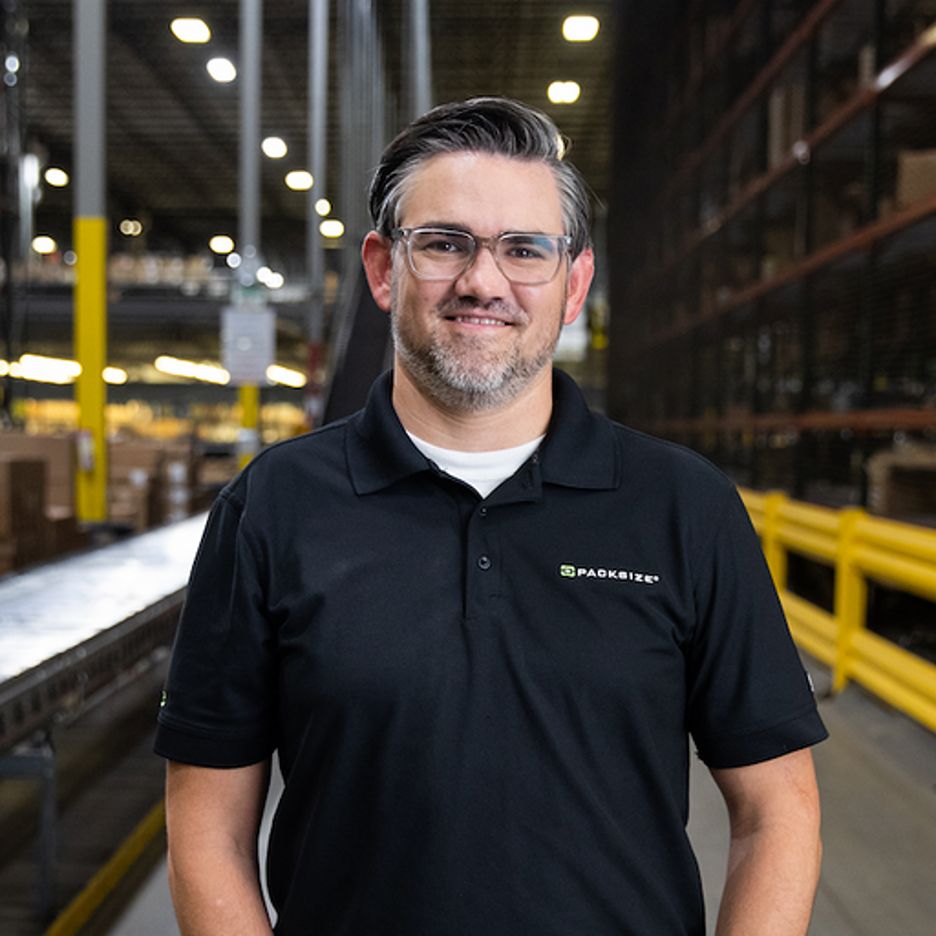
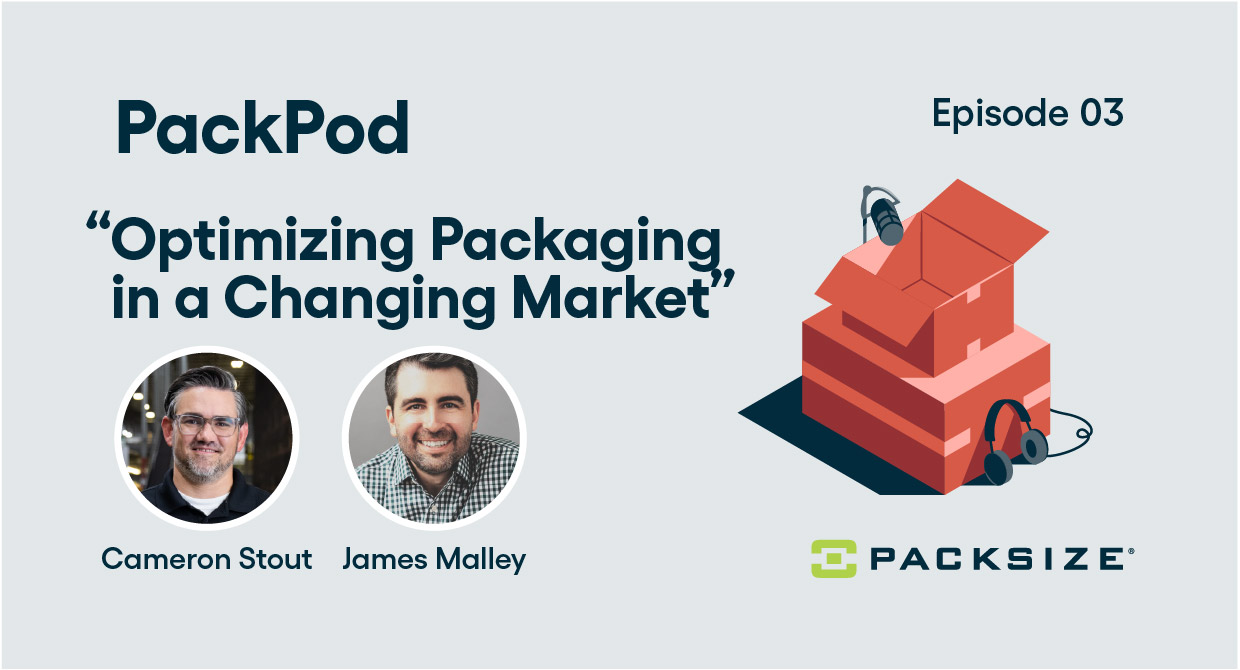
Join Cameron Stout, VP of Partnership Development at Packsize, and James Malley, CEO and Co-Founder of Paccurate, as they break down how hardware and software work together to drive packaging efficiency.
You’ll hear how rising transportation costs, shifting carrier rules, and increasing pressure on margins are bringing packaging back into focus – and why even small dimensional changes now have a big impact.
In this episode of PackPod, Cameron and James explore the intersection of automation and optimization, and what it takes to build a packaging operation that performs at scale.
Cameron Stout: Welcome and thanks for joining today. So my name is Cameron Stout. I'm a Senior Director at Packsize in the partners division. I’ve got the pleasure of having James Malley on the call today with me. Thanks for joining, James. Why don’t you give us a little introduction?
James Malley: For sure. Thanks for having me, Cam. Excited to be here with you for this conversation. Yeah, so I’m James Malley. I’m the CEO and Co-Founder at Paccurate. I’ve been in shipping technology since around 2009, focused on putting things in boxes as efficiently as possible since around 2018.
Cameron Stout: Yeah, and today, with this conversation, Packsize kinda represents the hardware portion of right-sizing, and James represents the software portion of right-sizing. So it’s a natural combination for us to come together and have a discussion about the state of the industry, where we see things going, and also innovation and maybe sharing a little bit about the work that we do together.
James Malley: That’s a lot of pressure to put on each of us to represent both of those categories, Cam. Can you explain – if I can give you an extremely leading question – can you explain to a non-hardware person what right-sizing is?
Cameron Stout: Sure. Right-sizing, the simplest way to explain it is that we’re converting a long piece of corrugated into a box that perfectly fits whatever you’re shipping. So, rather than you getting something on your doorstep where you’ve got a pen and it looks like the box could fit a shoe, we’re going to be able to make that box that fits the pen perfectly.
Our hardware is actually converting and taking information from a customer system or from some sort of dimensioning device and saying, “Okay, this is the exact size that it should do.” But in order to do that, there is a software component. So what is the software component as it pertains to right-sizing? How does software play a role?
James Malley: Firstly, I’m kind of jealous of the terminology involved here, because “right-sizing” rolls off the tongue and is easy to understand, whereas mine is “cartonization” -- Which I think most people in the industry know, at least at a high level, what it’s supposed to do. The idea is you have an order drop in the warehouse and there is some software, or algorithm, or process by which the right packaging is identified. So, that could be stock boxes, mailers, bags, or a Packsize machine. That’s really where we have focused for a long time. We started with a point solution cartonization engine that we thought was really fast and flexible and over time built a platform of tools around it to better support our customers.
Cameron Stout: Yeah, and for better or worse, I describe your product as the world’s best Tetris player. It’s the fastest, smartest, best Tetris player that exists. So I wanted to get your thoughts on what you’re seeing out there, what you’re seeing in right-sizing, the automation space, and then the software space.
James Malley: I think the focus on packing and packaging efficiency has gone through a few lurches forward over the past six years. The pandemic kicked off renewed interest – costs started exploding and companies step back, take this holistic view, and they’re like, “Oh there’s more than labor in front of me. There’s actually things I can do to effect a bigger cost center.” I think that’s actually happened again this year, really. It’s kind of the perfect storm of reasons, too. You’ve got rising costs, you’ve got shrinking margins due to tariffs, you’ve got a Gen Z-centric consumer base that is far less tolerant of perceived waste, even – and so, the trend year-to-year and season-to-season seems to lurch between “Ok, we’ve got to figure out picking or labor. We’ve got to figure out a way to bring robots in or whatever the automation is to fix labor,” and then it’s like, “Well, wait a second. Now we’ve got to go fix packaging or packaging efficiency so we’re not lopsided.” So, at this very moment that you’re asking me this question, it seems like there’s a massive resurgence in interest in this. Are you seeing the same?
Cameron Stout: Yeah. And to rewind the tapes a little bit, I think that you’ve also experienced rapid advancements in hardware. The machines and capabilities that exist today just flat-out didn’t exist five years ago – they just weren’t fast enough. In turn, if you wanted to right-size, you had to be A) very committed, but then you needed to be able to withstand a few hurdles. I think that those hurdles – operationally, it’s still a different kind of implementation – it's a different workflow and you’re fundamentally changing the warehouse by putting packaging automation in. However, those hurdles are much smaller today – just from a sheer speed standpoint. I think that’s really driven adoption and we’re kind of seeing the same thing. We’re having a banner year at Packsize, on top of a banner year, on top of a banner year. Our growth rate is bucking the trend that you’re seeing even in corrugated in general. Corrugated, on the whole, containerboard, or actual manufacturing is down, but Packsize is up – which is an exciting thing to be a part of – but, I think a lot of that has to do with just overall capabilities. And then, when you talk about adoption, I think the thing that’s pushing the market is that you’re seeing very large announcements from very large enterprises saying that they’re making a cognizant effort to right-size. You see that with Walmart and you see that with Amazon, where they are telling the world, “Hey we are doing this,” and they’re telling the world for a reason. And the main one is that the customers are demanding it, but then also from a cost-savings perspective. You alluded to it, but the costs keep rising and if the costs are not rising fast enough then the rules get changed. It’s a very convenient thing when you own the majority of the supply chain and you can write the rules and somehow, someway, if one group makes a change then the next group makes a change. From an analysis perspective, when you guys are looking at it – there's been some recent changes and maybe it’s too early to tell, but in the last couple months FedEx and UPS have fundamentally changed their round-up rules. How has that impacted things? Are you seeing that in simulation data right now?
James Malley: Absolutely. This is kind of a salt-in-the-wound change, because there was an onslaught of – not just the GRI (general rate increase) – the GRI is not that thing that everybody waits for anymore. It’s really where are they going to slip in surcharges that I didn’t foresee that now I have to account for and model out. So it takes a lot more work to anticipate and forecast what your costs are going to be, but the fact that they changed the rounding rules. They used to follow normal rounding rules so if your package was 5.4 inches, then we’ll call it five; if it’s 5.5 or more, we’ll call it six. The justification is not super clear to me, but they did that and what it’s cause is a surprising cost increase, especially for everybody but the top 100 shippers, in terms of volume, that may have negotiated out really impactful dimensional weight rating. Everyone else is seeing this increase and it’s not something they can negotiate, because it’s a process change that the carriers announced. It’s not like this is an extra fee based on your contract. We see that a lot. I actually have a genuine question for you that I was thinking about this morning. I know that one benefit of On Demand Packaging is that it can actually end up saving space in a warehouse, because – you talk to folks that don’t have any packaging automation and you get on a Zoom call they’re squished between pallets of various types of packaging. I was curious if that has been driving more interest – some of these folks that are investigating ASRS on the other side to save space? Is that a more top of mind reason now, because of economic uncertainty, where they’re like, “We can’t build a new location right now, because that’s a big bet. We need to make the most of what we have.”
Cameron Stout: Yeah. It definitely is. If you just think about it, if you're a medium to high shipper, you're going to need to have a lot of on-hand inventory. And then if you don't, then you're relying on a third party to bring things in, which also has a cost attached to it. There's value to it, and you get a little bit more predictability with your inventory. But most of the time when you walk into a warehouse that's moving a tremendous amount of volume, you'll just see racks and racks and racks of corrugated and stock boxes. Because, say you're running 13 different sizes, you need to make sure you've got enough stock on hand because if you run out, then you're out. What do you do? You have to start making costly decisions. And sometimes, even our customers or potential clients don't even understand the impact of that. What happens if you run out of your largest runner? Well, you usually have to go up in size. You go up in size, not only does that box cost you more, but it's gonna cost you more just going out the door. Not to mention if it used to be a game of inches. Now it's a game of fractional inches. So literally every millimeter counts at this point. For the most part, most of our customers can handle one to two truckloads of material. Usually, in most warehouses, it's about 200 to 300 pallet positions. We're able to reduce that down to 52. That obviously makes room for other things. It's all about density because real estate has not gotten any cheaper. It's not going to get any cheaper. So how much value can you extract from every square foot of your warehouse is really the true question. And we can help with that. In some cases, it's a big driver, especially if it's a brownfield, where they've been there for a while. It's just like your house. When you first move in, you've got all this room. Everything feels spacious, and then ten years go by, and then you need to do three truckloads to Goodwill or to Savers just to clear space. So for us, it's that. But then the last point on that is obsolescence too. If you're using a small amount of bail sizes, corrugated can only last on the shelf for so long. If things shift, say your highest runner becomes a CRD runner now, you're just sitting on that inventory. It's gonna go to waste. It's not going to be useful anymore. And we see that happen about six months. Then, say you've got sweat dripping off your forehead in the middle of Atlanta in a non-air-conditioned warehouse, then you can take that down to three months in the summer environment. So with you guys, I know that you've been working a little bit about the actual operation of packaging. How do you solve that problem from a software perspective? You’ve got some really innovative ideas and I’d love to hear about how you’re thinking about the problem – just defining it and what is the problem, and what does it solve?
James Malley: We started with this point solution and the attitude of, “we'll take your order data and send back the packing answer as fast as possible. We're not gonna bother anybody. We’re just this little augment that you can slide in the side, a high-impact cost-savings lever, and we'll stay out of everyone else's way.” That’s evolved over time. Our optimization – we optimize for cost – so cost could be negotiated carrier contracts and what that incentivizes in terms of packaging, it could be material costs, labor costs, it could be hazmat – put this hazmat item in this box and you get a fee, etc. Once that’s in place and people get used to it – it's like, “Yes, Paccurate’s driving our packaging decisions in real-time, I get it.” But what we’ve found overtime, after having especially larger customers for longer that they wanted more control. They would get a new SKU that was fragile or get some item that was squishy, and the only way for them to deal with modifying the code base was to either bring a basket of muffins to their internal IT team and hope that they’re nice enough to jump their roadmap for you, or look for room in the budget to pay your WMS to make a code change. We just found it was a huge source of frustration for the operators not being able to be hands-on and just make a change. It really shouldn’t be this out of reach thing to control what’s going on on the pack line – very basic SOPs and some more complicated ones. So we launched something we call PacManage, which allows our customers to log in, say, “I have an order. It’s got this category of items that requires this special consideration. Let me make that rule change, test it across a big order sample to make sure it doesn’t cause any unintended consequences, and then deploy it live without any code change.” While we are founded on this idea of optimization and really complex math, it’s been really interesting the almost emotional reaction from people just having a little bit more control over part of their operations. So, that’s what we’ve been most excited about lately.
Cameron Stout: Yeah. And can you expand on the IT lift involved in making SKU-level changes? That’s kind of what you’re talking about. What does it look like for a standard customer? You talked about taking muffins to the IT team – what are the muffins for?
James Malley: The muffins are to indicate that the IT team – who almost certainly is extremely busy and putting out fires themselves – that they should pay attention to your problem – and your problem might be pretty significant. It might be this new SKU we got is always showing up busted into a million pieces, and I have no way of solving that because IT is busy. All I can do is try and solve it with process. I can stick a Post-it note next to all the pack stations that says, “If you see this item, throw some bubble wrap on it. If it’s a complicated category of SKUs, I may have to solve it in a brute-force way by saying to my packers, “just put 4 feet of bubble on everything,” and then this isn’t my problem anymore because IT was busy and I fixed it. Obviously, unintended consequences of that are a tremendous amount of environmental waste and almost certainly a huge increase in transportation costs. Giving a little bit of, not just control, but speed and the ability to react to changing conditions, is what’s resonating.
Cameron Stout: Yeah. And I wanna add a few things to that, because it does boil down to this master data concept. Dimensions, in general, and dimensional integrity is more important now than it ever has been. Let’s just take off the Packsize/Paccurate caps for a second. If you're going to maximize any kind of advanced technology where you’re literally buying it to increase the density of your warehouse – specifically like an ASRS – if you want to you need maximize the available storage and the available space you’ve got, you need to understand how large the items are that you’re storing. If you’re off on that, it’s very difficult. The other part is that manipulating master data has a lot of unintended consequences that have nothing to do with the warehouse. If you are meddling in ERP data, and all of a sudden you’ve got manufacturing teams that have questions (if you’re a manufacturer) or you’ve got procurement teams that are asking, “Why was this changed?” -- you have your side of the story, but they have their side of theirs. It almost just calls for two separate, not necessarily redundant, data bases in order to do that. And what you’re saying is, “Let’s bring over your master data as it sits, but we’re going to give you the ability to make adjustments on the fly so that this data base, that doesn’t have any consequences outside of the four walls of the warehouse can be adjusted.
James Malley: You could augment your item master, as it were. I think that’s definitely one of the biggest surprises, to me, in the early days, especially as we started to work with larger enterprise clients, is the item master – the database that’s supposed to say how big these things are – is a weirdly political hot potato. You run the risk of causing real organizational problems with – maybe the marketing team owns it in your org, or maybe accounting owns it in your org. One universal thing that we’ve heard from all of our customers is that they can’t trust any data that comes from the manufacturer, which is really interesting. I actually don’t know why that is, but that’s not a path that’s advisable to go down.
Cameron Stout: Absolutely. One thing that we run into quite a bit, it’s a question we get, especially in the partner space is – Ok, you’re going to right-size packaging and we’re going to make a box that perfectly fits whatever you’re shipping, or perfectly fits it in a reasonable way so that you can still back into it. A common question we get is, “How am I going to instruct anyone to actually pack into these boxes? And how is it going to not slow us down?” I think that everyone thinks of it as this curated dance that needs to take place. A lot of times we say, “Hey, you’re operators, they have eyes, they have ears, they have hands, they’re going to be relatively quick on their feet.” Say they just really needed a crutch to do that – how would you go about solving that problem?
James Malley: The way we think about it is just another cost. Do you want a packer spending an extra 30 seconds fitting something together? Probably not all the time, but what if the packaging configuration avoids a really expensive surcharge? Maybe you do. Every organization is different and have different costs in each of these areas. It's really just about calibrating what you’re optimizing for any given shipment. That’s how we think about it. On the very basic level, and this might be more common with SMB-level customers, but they might just reserve 5% of the space and just use that as this is enough wiggle room. Once they start banging away at it and looking to continuously improve then they move away from that and try to think about costs the way I described.
Cameron Stout: Alright. I wanted to get real for a second and talk about two things: One – we like to paint a picture of all the benefits and everything that is good, but what do you see on implementation? What are some of the operational hurdles that you guys run into that prevent customers from maximizing the value of your product? That or just, what do they need to be thinking about? How do they get prepared for your journey?
James Malley: We already talked about dimensions and that’s really essential to everything we do. They don’t have to be perfect, but there should be an opportunity to perfect them or improve them over time, as a matter of course. We spend a lot of time doing ROI analyses and simulations and helping people get comfortable with KPIs first, because some WMSs are easy to hook into; others might charge you some money to do it. Someone on my team said the juice has to be worth the squeeze – or there has to be enough meat on the bone – we've got a lot of idioms here at Paccurate. Those are really the two big considerations. The idea is, if you have that prerequisite data at least in a decent state, if you can make the time and prioritize the integration – after that, then everything becomes a lot easier and it’s keeping both our and the customer’s eye on the ball of where we’re trying to get is an easier life at the end of the tunnel.
Cameron Stout: For us, a lot of it is the same. The challenges are the challenges, and we’re both trying to solve the same problem, which is what makes us such strong partners. You couldn’t find a more natural pairing than Packsize and Paccurate. It’s dimensions. I think the second piece almost comes before you implement anything – it's thinking end to end and thinking about a holistic solution. How are you going to get cartons to the right place, because they are no longer going to be sitting on the shelf next to someone allowing them to make the bad decision. We’re making the decision for them about what box something should be picked into. It’s process flow – it's in and it’s out – and just making sure that you're not creating bottlenecks and making sure that you're matching rate of different systems. Because if you've got one system that can move 10 times faster than the output, it's kind of like having a V8 engine with a half edge tailpipe. It's just going to cause a lot of unintended consequences. So, I think operationalizing it and having a plan to say, “Okay. This is how we are actually going to take this technology and integrate it into either existing workflows or make changes to make sure that it does integrate well.” If you can get that right, then it's a matter of just continuing to twist the knobs, which is why I love what you guys have with the PacManage and the Pack Control system. It really does allow you to make those changes – it's super interesting to see how, once you have the equipment, once everyone's wrapped their arms around it, right, you learn how to play the fiddle, so to speak. Then it becomes like, alright. Well, are you actually maximizing the investment? And what we see and what the manifestation is usually boxes are either way too big or way too small. If they're too big, great. You're just burning money, and you're just paying much more than you need to in today's day and age with the technology that's available to you. But if it's too small, then you're creating downstream problems where you need to repack because, either someone decides to just shove it in there and then a package explodes as it's vibrating or as it's getting moved around or as it's, sometimes, just getting lofted into a truck, you've got things that break, and then your product doesn't get there on time. And then back to just the too big, the chances of it breaking are just significantly higher. So if it's too large, you can either spend too much money on void fill. You can, or you just do nothing, and hope that everything gets there okay.
James Malley: You said the word holistic, which, gets used a lot in our space, but there is something different about the last 12-18 months where automation specifically, it seems like consultants and integrators are taking a step back and looking more. I think about back when AMRs really came onto the scene, in earnest and kinda took the industry by storm. The follow-on effect was, like, “Well I got rid of this bottleneck in picking – good job, everybody!” But then their only recourse was to go – because the bottleneck would move to the pack station – their only recourse was to add 20 pack stations because they didn't really know what else to do. You mentioned our partnership is like a no brainer, and we go into a location together and we figure out how to quickly design the best solution. But I've been surprised how much we – and I think you, too – work with those picking automation providers now because everything's so interconnected. I can't operate in this little bubble of, like, “I'm gonna make the best packs that the world has ever seen.” Because if it screws up some sort of picking flow or whatever it is on the bot or in the automated storage and retrieval system – not gonna work. It's not gonna have the intended outcome. So it's just really interesting how these segments, like SLAM and upstream segments, are starting to collaborate more. I don't know if you have any thoughts on that change.
Cameron Stout:
Yeah. I think the word that comes to mind is differentiation. So, what you've seen is that, either companies have been repping using the same picking technology for a very long time, and then competitors have also risen. So the picking space is extremely competitive, whether it's a traditional technology and others have access to it, or whether it is upstarts and new ways to solve the problem. There’s 10 roads to Rome rather than two. Everyone’s got a different way to do this. So, how do you differentiate yourself in that environment when maybe there is top pressure on you that didn’t exist before? Maybe you need to figure out how to further optimize. Say you put some picking technology in and it takes 70% of the labor out. Then what? Where do you go from there? And it’s not like the lean teens in these groups or the continuous improvement groups. It’s not like, “Well, way to go, guys!”
James Malley:
Time to pack it in!
Cameron Stout:
Yeah. “Let's go find ourselves a hobby!” Not how this is gonna happen. You're on your improvement, and driving costs out of the operation is always the key. So I think the most natural place to look is to say, “Okay, where's our next biggest waste bucket?” And, really, what we try to get people to understand or, maybe the most difficult bridge for us to cross is that you're talking about, with our solutions, it's like you have impacts within the four walls. And those can be labor. Those can be material. And those have real time P and L benefits just for that actual warehouse. But, what doesn't, which is actually our largest impact, is outbound logistics because it's outside of the warehouse, which usually, with most companies, it's structured as outside their P and L. So it's just an entirely different group. That may earn the employee of the year award for the head of transportation, but it's not going to do anything. And we find ourselves just so commonly associated with VP of Ops, Director of Supply Chain, VPs of Supply Chain. So you're talking to this group, and it's like, “Okay, I love that. That's gonna help me with my internal justification. But it may not help me.” It's kind of an interesting dynamic that we have.
James Malley:
We run into that all the time too. I don't think anybody's ever said this, but it's like, “I am working really hard collaborating with you on this solution to give that other guy a win in the other department that has no idea how hard my job is.”
Cameron Stout:
Everyone has KPIs, right? Everyone has OKRs – whatever flavor you wanna call them – and you're literally gainfully employed to hit those. It's not the most cynical thing in the world. It's just like, “Hey, this is what I’m measured off.”
James Malley:
That's just how organizations are set up. So what is the answer to that? Obviously, it's not blocking adoption in any huge way. But do you have to go all the way to the CFO to really make the business case to the organization? Or is there enough, in your mind, cross collaboration and things like that to make it you don't need to run to mom to explain the impact.
Cameron Stout:
I think it's dependent on the customer. It's more of a sales challenge than anything. It's just managing the decision-making unit, making sure that you attempt to gain access. And if you can't gain access, then you need to coach your champion or whoever's involved on how to tell the story and how to tell it correctly. And also, make sure that they understand, “Okay. Well, here's how it's going to impact inside the four walls. Here's how it's going to help you. Here's the benefits of it. Make sure that there’s a collaborative effort to build a business case that everyone can stand behind. But then, at the same time, there’s a lot of other value to your organization. There’s marketing value on the sustainability impacts. There’s outbound logistics savings. There are reverse logistics implications with reducing damages, which is a major concern across everyone that shifts directly to a consumer right now. So, I think there’s just a lot of different ways to go about it. But if I had the magic wand, there’s just two things I would solve. Number one is just getting people to understand the cost of doing nothing. That’s number one. Status quo is the biggest enemy. It’s easier just to stay comfortable than to get uncomfortable and to grow. And then the second is being able to cascade the message or the value throughout an organization with a little bit more ease.
James Malley:
Yeah. That makes sense. It certainly seems like in the past six months, integrators specifically starting to incorporate transportation savings in their business cases – in their bids. Which almost feels like kind of a hack or, an obvious thing – and I might get in trouble for generalizing the percentages, but I think transportation average is 50 to 60% of the cost, whereas labor is 40 to 50. And so if picking automation saves 40% of picking labor, that's really only 10% of total labor. There's this whole other 10% of transportation sitting over here. Why wouldn't you incorporate any kind of strategy to claim it and bring it into a client location? So I've seen that come up and it seems like they're getting some traction with that.
Cameron Stout:
It's a massive lever. It dwarfs what we have in material savings. It dwarfs what we have in void fill reductions and other things. It is the largest bucket, and then it's also becoming a harder problem to solve. Because every time you think that you've solved it, okay. Well, here's your goalpost. The field goal used to be good here. Now it's not because the goalpost is here. And it's just that it's a dynamic thing. And the rules and the surcharges and all of these things, they are ever evolving.
And it seems like it's just happening more. And that's what I've seen at least. You talked about at the start of this podcast. It's just GRI. Everyone okay. The sun comes up in the east. Calendar flips over. January first, January sixth, whatever day. The first week of January, I've got a new set of charges that I'm just baking in. It's coming. I know it. But what's been happening is just more of tweaking the thing, much to the much to the chagrin of mathematicians worldwide.
James Malley:
And fourth grade graduates.
Cameron Stout:
Yeah. I mean, I worked hard to understand that. And now I'm just lost.
James Malley:
So I feel like we could talk about Ops. This has been a very operational heavy conversation. But I think it's also worth mentioning our love of solutioning is not the only thing that binds Packsize and Paccurate together. It's really the mission. Talk about real talk, in The United States, at least, we don't really lead our sales pitch with the sustainability benefits. But I think it is as ingrained in your organization of the why we do what we do, as it is in ours. Is that something you could talk about a little bit too?
Cameron Stout:
Yeah. I mean, I think it's interesting because there's a lot of different reasons. And some that I could speak to on this podcast and some that I can't. But I think just in general, sustainability, in a lot of people's eyes, is just something that adds to cost. So when you lead with that or when you talk about it, then there's just that natural association. It's this almost direct correlation to say, “Okay. Well, this is probably gonna cost me more money to do the right thing. So my budget doesn't have these factors built into it.” And actually, it's doing the opposite. “My budget is getting tighter and my controls are getting tighter. I'm asked to be doing more with less.” It's literally every company everywhere. Do more with less. So, these groups are no different. But I think the separator and I think how we approach it is to say, “Okay. It's sustainability that's got a positive impact, and it's got a positive payback, because when we find the right customer profile, our machines net out very quickly. And you get the sustainability benefits because it's a pragmatic solution. It is a pragmatic solution to the problem. It's simple to understand. Just make the box smaller. You can fit more on it. You use less paper. Paper requires trees. Trees require water and sunlight and tending. It's all things where it's pragmatic. And I don't know that every sustainable solution out there is like that. And then there's also just other connotations that go along with it. But it is really the right thing to do. And just, you know, the personal part of it for me is just, you know, I don't really care where you land on the political spectrum. All I care about is that my child has clean air to breathe and has an environment that is worth living in. And even if it's just the immediate environment. Forget all the global stuff, I just want my child to have clean air to breathe, and I don't think that's too much to ask.
James Malley:
Yeah. And I think you work on this problem set for long enough. It's just stunning just because the economies of scale we're dealing with. Even making tiny tweaks to packaging have this cascade effect throughout the supply chain. I mean, speaking of air debris, I live in a city. And so, the idling delivery trucks all up and down the block every day, I worry about that with my kids. And I think what we found is that if you're able to shrink your average box carton size, by, say, 13% or whatever it is, 20%, it almost acts like a liquid. So you almost have the exact same reduction in truckloads over time. And so the CO2 equivalent reduction is truly massive at scale when people invest in this. And to your point, whether they're trying to be greener or not, they're going to be
Cameron Stout:
No. But if you do it for no other reason than it's gonna save you and your company money, then then do it for that. And that's the nice thing about it is that we don't have to win that battle every day because we're winning the battle by proxy. You know, what you do, what we do, we're just winning it by proxy. So, overall, James, really appreciate the time. I think this was a great conversation. Always love talking to you. Enjoy the partnership that we share. Look forward to continuing to build and reach greater heights. So thank you.
James Malley:
Thanks, Cam.