Calculate Your Savings
HERE
Boxes Created 1600000000
90000000 CO₂ Saved (lbs)
4518639.77 Trees Saved



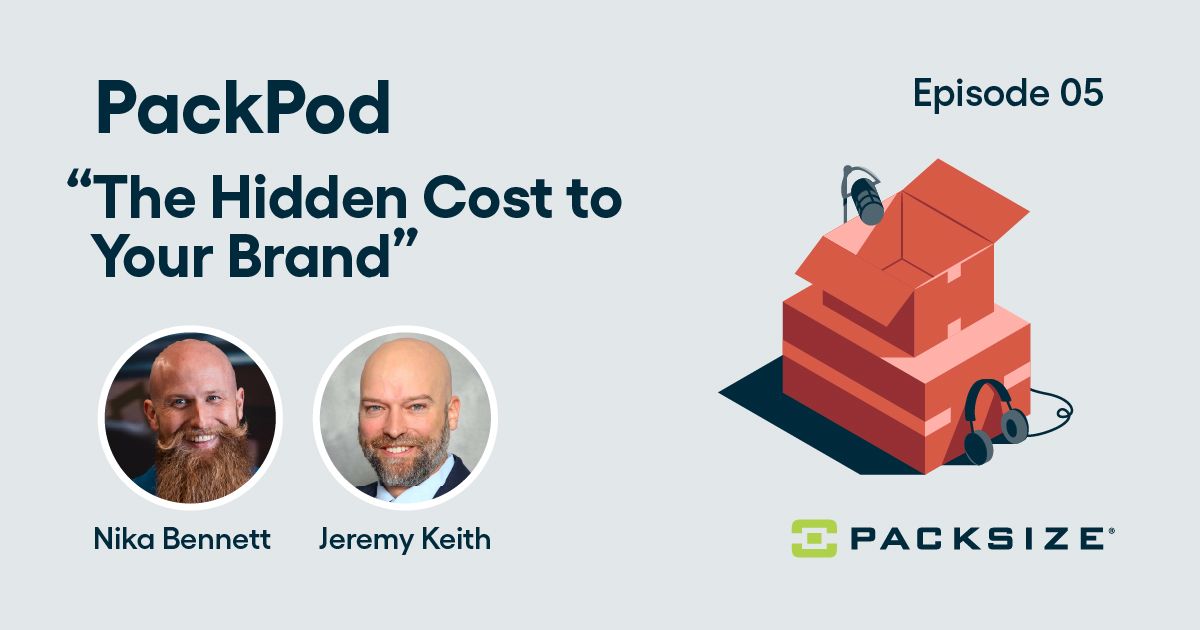

Customers never see your warehouse or fulfillment process. What they do see is the package that arrives at their door. Every box communicates something about your brand, whether you intend it to or not.
Join Nika Bennett, Global Director of Channel Operations, and Jeremy Keith, Senior Director of Solutions Development, as they discuss how oversized packaging affects customer perception, brand trust, product protection, and the overall delivery experience. From damaged products to unnecessary waste and oversized boxes, they explore why packaging has become a critical part of the customer journey.
In this episode of PackPod, Nika and Jeremy explain why right-sized packaging isn’t just an operational decision. It’s one of the most visible expressions of your brand.
Nika Bennett: Hello, and welcome to this episode of PackPod. We are going to talk about the hidden cost of oversized packaging. My name is Nika Bennett. I run the global channel operations team here at Packsize. And today, I am joined by Jeremy Keith.
Jeremy Keith: Hi, my name is Jeremy Keith. I'm the senior director of solutions development here at Packsize. I lead teams of engineers that work hand in hand with our customers to help enable them to get the most out of our machines in their facility.
Nika Bennett: I think there's a really simple statement to set up our conversations today. It's really that your warehouse is totally invisible to your customers. Your packaging isn't. And if you think about it, companies spend millions of dollars building their brand. They obsess over websites, social media, advertising, design, customer service – every single portion of the customer journey. But at the very end, they hand the last impression over to a cardboard box, something that's been in existence for years and hasn't changed all too much. So regardless of what you do in your facility and what we normally talk about on these episodes, customers never see your automation. They never meet your fulfillment team, and they don't know how many people pick the order or how effectively your warehouse runs. You're judged by one thing, and that's what they can actually touch, and that's the package. We've all had moments like that. I want to kick it over to Jeremy. You've spent years helping companies, on behalf of Packsize, rethink the experience from the engineering side. But before we dive into the technicality of it, as a consumer, what's one packaging experience that's really stuck with you?
Jeremy Keith: That's an interesting story for me, because I remember a long time ago I used to engineer interactive museum exhibits, and we would have to shop for components sometimes to use as part of the experience. One time I needed a USB hub, and I went shopping and ordered a USB hub online. There's a ton of no-name brands and different products out there, and I'd never heard of this brand before, but they seem to get decent reviews. The product's name or the company's name was Anker. And I ordered the USB hub from them, and it arrived in a very nice primary package. And I was kind of shocked by that. It's just a simple USB hub and came packaged very well. And when you opened it up, you could tell that they genuinely cared about the product that they were shipping and selling. And as I used it, it performed fairly well too. But the part for me that stuck with me is every time I go to order an electronic device, I end up choosing Anker because I know that they care about their products, and their packaging actually left a lasting impact. I mean, it still continues today. If I see an option available to order a USB cable and it happens to be Anker, I'm gonna get it.
Nika Bennett: I like that. For me, it's a little different. Normally, I have the opposite experience. I spent $300 on a pair of headphones, was super excited, really flashy on the website. I got it. Edge of the box was crushed. And now anytime I hear a pop or have a Bluetooth problem, I blame the shipping process even though, really, it's probably user error if we're being real. And I know that's not unique. It's something we hear day in and day out. Everybody's seen unboxing videos, whatever it might be. If you nail it, you got a customer for life, just like you called out. I am curious, though. Have customer expectations around packaging really changed from a commerce market perspective?
Jeremy Keith: I would say so. You can even find evidence of that in social media. If you go to social media, you'll often find people publicly shaming companies that are shipping their product in oversized packages with tons of void fill material, and it goes on and on. If you go to Reddit or you go to X, you can find tons of examples of poor packaging and the impact that it has. And, really, every time you send something to somebody in a box that's way too oversized or contains a ton of filler material, you're sending them a big Inconvenience because at the end of the day, they're going to have to break that box down. They're going to have to find a way to fit that oversized box in their garbage, and they're also going to have to figure out something to do with all that excess filler material.
Nika Bennett: I think it's overlooked a lot of the times by these organizations out there. Because for me, I live out. We're in a house. I have a garage. Things are dropped directly to my doorstep, and it's easy to move things in and out. But plenty of people on my team as well live in large cities, and I never really thought about it this way. But, great. Who cares what UPS thinks, in my mind, but I need to be able to take that package up 10 flights of stairs. And what if instead of having a garage or a large garbage can, I have a 400 square foot studio apartment? I unbox that. I gotta worry about the pillows, the material. I gotta heft it back down. And more and more, putting yourself in that scenario and situation, even though you think you might be better protecting the package or whatever it might be, it really ripples just above and beyond, that first impression. It's what comes after. How quickly can I use what you sent me?
Jeremy Keith: Then the other thing that goes along with that is I know that those excess shipping charges to ship that huge box, I'm paying for those too in the end.
Nika Bennett: Absolutely. There are so many things that go into that, and there's a lot of quantification that I think is overlooked pretty frequently. You can have a damaged box arrive. But what happens when that product is actually damaged? I mean, on your team, typically, are we quantifying a lot of that above and beyond just anecdotes?
Jeremy Keith: We actually factor damage rates into the business case, and we have a team of packaging engineers that will analyze the integrity of the box, and we'll also perform some tests on it. And we'll be able to factor in what the improvement in damage rates is and build that into the business case that highlights the value of the total solution to the customer, including that.
Nika Bennett: I like that. What's one packaging detail that anybody watching this right now should start to evaluate in their own operation related to brand customer experience and oversized packaging?
Jeremy Keith: I would say customers may never see your warehouse or fulfillment process, but they do see every package you ship. And, ultimately, the package that you're putting in their hands is the first impression of your company. Why would you ever wanna put something that's oversized and, seemingly thoughtless or careless, in their hands as the first impression and give them more inconvenience that they have to deal with in their home?
Nika Bennett: For a large majority of e-commerce companies – this one's kind of a curveball – but if the packaging was the only thing the customer ever knew about a large majority of these e-commerce companies, what type of stories would be told based on just that box?
Jeremy Keith: For me, the story, or the communication is pretty heavy. When I see something come in a good package, I think the company has pride in their product. They care about sustainability. They also care for the presentation to the end user. They Also focus on efficiency and profitability. It's one of those small details that, if a company is paying attention to, the consumer can take comfort knowing that the company is also focused on the bigger and more important details. In some cases, it can also communicate some unexpected things when I order something small and it comes in a package way too big. Sometimes I have to defend myself to my better half and explain that I didn't spend thousands of dollars. It was just a cable that came in a box the size of a bathtub.
Nika Bennett: I had that the other week, and we talked offline. But, the perception even just in my house of how much I might have spent on something, it's pretty quickly skewed by what that box looks like and what I have to go secretly break down from the recycling. So, I guess, any final thoughts on just any of this related to customers really interpreting your brand solely based on that box? Because, again, when we opened it, they never see your warehouse. They don't know what your fulfillment team looks like or what you're investing in. So what else do we need to know or take into consideration with this?
Jeremy Keith: I have a little story I wanted to share as part of this. One of the perks of working at Packsize, we actually get to use Packsize machines to make boxes for personal items we ship. I love sending items in Packsize boxes. It just feels good when you put an item in a box that's perfectly matched to the thing that you're shipping. But, also, you don't have something rattling around and you don't feel the weight shift. It just Feels solid. And for me, when I'm sending that out and I know the person receiving that is also gonna see that same level of attention and care, I know that they're going to take a little bit more comfort in the person that was sending this was caring about the product that was being transmitted to them, and, it's pretty great. But one of the other things I've done once was I actually shipped out a live bonsai tree. I brought the tree over to our EM7 machine, and within a few minutes, I was able to make a custom right-sized box to ship the tree in and also make some protective tubes to keep the tree in place in the box. That tree ended up arriving to the person in perfect condition, and it was a really cool story to Tell that I was able to ship a tree in something that was made by trees, and it arrived there in perfect condition, and the tree did its job in protecting the tree inside.
Nika Bennett: I think you nailed it, because every package really does communicate something to the person receiving it. Right? Is it a premium brand? Was it thoughtful, like your bonsai tree? Is it sustainable? A tree and something made out of a tree, or is it frustrating? Because whether we realize it or accept it or not, every shipment reinforces or weakens the trust or the story we're trying to communicate.
Jeremy Keith: Yeah. Absolutely. And it's interesting because every once in a while, I'll receive something in a package, and, there's a little strip that gets peeled off, and they throw it inside the bag, and they're shipping it to you. And it's like, they're shipping me their garbage. They didn't even care enough to get rid of their own garbage. They're gonna ship it to me to have to deal with. So, why ship something that's gonna be a bad impression and make the customer feel like you're imposing additional responsibility on them and inconveniencing them? Put it in a right-sized box, that's as small as possible, that creates the least amount of impact to them to discard and get rid of, and give them an overall good experience. It's the first impression they have of your brand.
Nika Bennett: Alright. Great. Thank you so much for your time today.
Jeremy Keith: Thank you, and thanks for hosting this.
Nika Bennett: No problem. See you on the next episode.