Calculate Your Savings
HERE
Boxes Created 1600000000
90000000 CO₂ Saved (lbs)
4518639.77 Trees Saved



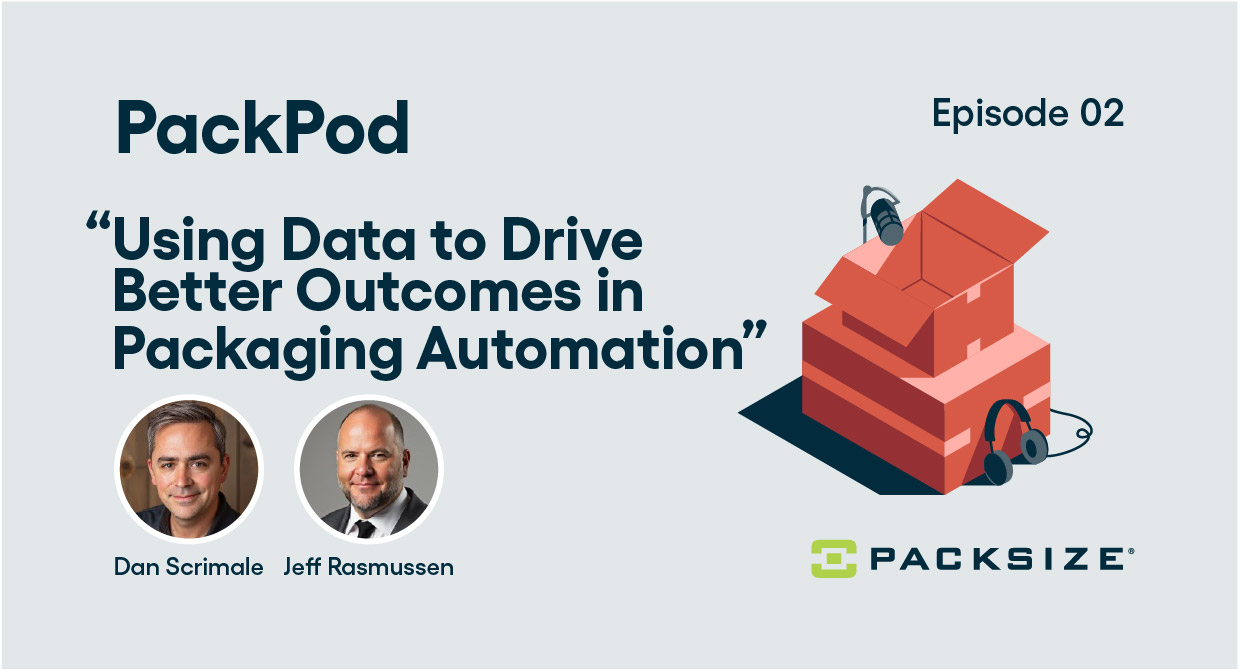

When it comes to packaging automation, the hardware often takes center stage. The machines are visible, tangible, and easy to comprehend. But behind the curtain of every high-performing packaging process flow is the hardworking software that keeps these machines running, improving, and adapting over time.
Join Dan Scrimale, Senior Director of Global Product Development, and Jeff Rasmussen, Senior Director of Partner Solutions, as they explore the role data and reporting play in modern packaging automation. You’ll hear how real-time reporting helps teams manage peak demand, reduce waste, and get the most out of their packaging systems, while also preparing for emerging regulations and more connected warehouse environments.
In this episode of PackPod, Dan and Jeff unpack the hidden value inside packaging data, and why reporting may be one of the most important – and underutilized – tools in your operation.
Dan Scrimale: Hi everyone. My name is Dan Scrimale. I'm the Senior Director of Global Product Development here at Packsize. You know, Jeff and I were having a conversation the other day about some of our software product capabilities. And it dawned on us that we talk a lot here at Packsize about our packaging automation solutions and our machines and what they can do for the business, right? But what we realized is the software, often times is, kind of the hidden gem and, behind the scenes, adding a lot of value to our customers. So Jeff, I'll let you introduce yourself and kind of talk about what you do here at Packsize. He brings in a wealth of knowledge and has an interesting background.
Jeff Rasmussen: Alright, thanks, Dan. Hello everyone. Jeff Rasmussen. I've been with Packsize going on 11 years now. My background has been largely within the software space, building our software product. A couple years ago, I transitioned over to implement solutions and work closer with customers. But I have worked on plenty of projects over the years and seen a lot of things. Dan and I met at one of our customers projects in NV one, I think, was our first interaction.
Dan Scrimale: Yeah, back in Reno -- Reno, Nevada, right?
Jeff Rasmussen: That's right. And that, obviously, was a very good introduction and relationship that led to these Walmart next Gen. Buildings – obviously, not just the two of us, but so happy to talk to you about reporting.
Dan Scrimale: Yeah, that project was a fun one, right? I kind of fell in love with Packsize there. I was a customer of Packsize at the time, right? It's just like watching the, you know, I mean, we build cool things at this company where our solutions are innovative and kind of like on the bleeding edge, I think of packaging automation. But they also make sense, right? They save our customers, including Walmart, a ton of money, whether it's corrugated savings or labor savings or whatever it is. And it's also nice to work at a company that feels, you know, that the mission is good as well, right? And you can kind of get behind and rally behind that. So, yeah, that was a fun project. We spent a lot of time there – and maybe more time in Reno than we wanted to, but it's cool to reminisce.
Jeff Rasmussen: Oh, I love Reno.
Dan Scrimale: So yeah, let's talk a little bit about our software platform. I'd love to talk about reporting. To me, PackNet Report is one of those modules that if you're not using it, you're falling behind. You know, there's a lot of times we see these customers that, they implement a solution – and by that, like we put a machine in the warehouse, right? They start using it to make boxes and they're done, right? “Hey, we did it. We're cutting edge, we're automated.” But you know, you've been around hundreds of these customers, right? Tell me your take on that. Have you squeezed all the value out of your solution on the day of go live?
Jeff Rasmussen: That couldn't be further from the truth, right? Most of the customers that we work with, their business is cyclical. They’re not stuck in one order SKU or one dimension, so to speak. Their business is ever changing, which also means that the products that are shipping are ever changing. The needs of the solution that we put in three months ago is likely very different than what their needs are today. It's the end of October. We're coming up against peak season for a lot of our customers. The demand for them next month – this time next month – is going to be different from what they're dealing with today. So in a very dynamic environment, there's no one solution that fits all. They really need to be looking at that solution and, from an operational perspective, keeping an eye on it and making sure that it still meets those goals that they had on the day that they started with that solution.
Dan Scrimale: Yeah, completely agree. And I think that continuous improvement, you know, it's funny coming from software, that's something that I think comes naturally to us, right? Like we ship MVPS in software, minimum viable products and software all the time. And then we learn and we polish and we improve and we incrementally kind of release more value in the software product. And I think sometimes we need that similar continuous improvement approach to the solutions. It's great, you got your machine there, but that's just the beginning. You need to really have a good understanding of – hey, first of all, before you even had this packaging automation machine, what did your operations look like? What were your cycle times, your waste rate, your trim rates – and how much were you wasting in material? What about labor costs? What about – so on and so forth. These kind of different metrics that you should kind of have an understanding of with your solution. And then how does PackNet Report help you, ideally, dial in those metrics and see improvement over those after go-live of the machine?
Jeff Rasmussen: Yeah, that's it. It's funny, you know, we've always had some aspect of some sort of reporting, This data is very valuable and we live in a world in an area of the warehouse where the data that Packsize has is not easily accessible by any other system in the warehouse. That's changing as automation evolves. But since I've been at Packsize, it's been a consistent – like this is really the only place that you can get consistent, reliable data about the size of the box that was actually shipped and put onto a truck. So, those goals and those metrics have certainly evolved over the years. And I certainly believe that we've got one of the best in class reporting platforms now, just because we've been at it for so long. But I remember, in Packsize Suite, you could export this data to an excel spreadsheet and load up a bunch of templates and do some reports. We've come a long way to a real time dashboard that you can just load up into a web browser and show you where you are right now. And then also viewing everything related to the OEE and how we talk about the performance metrics. It's become a really, really powerful tool for operations. So they really need to learn how to leverage that and keep an eye on it. You talked about void. There are – and perhaps they don't know that there are tools that Packsize has that if their void is not where it was, where they planned, that we can optimize that and go through a re-optimization and get their trim down.
Dan Scrimale: Void fill is a really interesting one, Jeff. With the things we're seeing with PPWR in the EU and these other regulations around fill rate, right? I think that's a really interesting shift in actually bringing regulation and holding manufacturers and other people that are effectively shipping product accountable for shipping responsibly – and not shipping a whole bunch of air. It'll be interesting to see how things evolve here over the coming years when that regulation comes into effect.
Jeff Rasmussen: Yeah, you're talking about the data that we have access to. And, you know, with any regulation – it's great to put a regulation in – what are you going to do when you go audit it and try to enforce that regulation? You have to have systems in place that somebody can rely on for that data. And Packsize happens to be in a unique position to be able to throw out a couple of reports and show an auditor, “Hey, this is exactly what was shipped. These are the items that were in that order. This is the box size. Are we underneath that 50% void limit or not?” So I think that the compliance for new regulations will play a huge part in that and that's coming soon. It's five years away before that regulation for PPWR gets put in place. It's going to be very useful for regulations. But you know, that's one thing to say, “hey, what am I forced to do? But what are the things that I can do in my operations just to be better, just to be cheaper, just to be able to ship more.” And there's a lot of hidden value inside of reporting. We talked a little bit about trim percentages. The corrugate that we're throwing away exactly equates to tossing dollars in the garbage can. So we talked about re-optimization – monitoring that. So, if I put the solution in place and I had a 5% trim target, what do I do when I get to 7% and do I even know if I got to 7%? Well, our reporting will tell you that your trim percentages are trending upwards. Now it's at what point do we re-engage with Packsize to reclaim the wasted dollars that were thrown away in the trim for the boards. That's just one piece. It's the simplest piece in my mind. It's a pretty easy metric to watch.
Dan Scrimale: I think another one is, you know, these machines, you kind of dial them in to their environment – and that's pretty standard, I think, with a lot of automation-type solutions. But another one I find interesting is, when you talk about machine up time now, you know, these machines, they can be expensive. You want to get every ounce of productivity out of them you can, right? So the ability to go in and stack rank the errors or stoppage reasons that you're getting on a machine and look at, “Okay, right. So, the top contributor to the machine not producing a carton is low air pressure,” or something like that. “Ok, great, let's go knock that one off and address whatever issue is causing that error and then kind of move down the list.” It gives you, as a maintenance organization or an operational organization, a punch list to go after the most costly downtime contributors in the environment, which also just helps streamline your operation and keep the machine up and producing.
Jeff Rasmussen: Absolutely. Again, it's just critical data for an operations team to just keep an eye on. And you know, there's a direct relationship between machine up time and maintenance schedules and the maintenance that we're doing on these machines. And I think that's often overlooked by operations teams. They may look at the Packsize system and say, “Hey, this machine's down a lot.” What they should be really looking at – again, there's those errors and building out pareidos to say, “Hey, let's go tackle the problems that are causing the majority of the downtime,” but then also correlating that to their maintenance schedules. Are they consistently maintaining these machines? Are they doing everything that they can to prevent any sort of failures in the middle of a shift? You know, we quickly become a mission critical piece of a warehouse and an operations team needs – number one, they need visibility into what's happening. But then they also need to be able to say, “Hey, if I plot this maintenance plan, then I can see that my numbers will go up.”
Dan Scrimale: And watch it, right? Watch it work, monitor that the changes you're making are having an impact. I think it both helps you identify potential issues and suboptimal things inside of your solution. But then you get to use it as kind of like the validation that what you're trying, what you're experimenting with is actually having an impact on the actual operation – and operators of the machine, right? Sometimes we see almost a lightweight gamification with some of our reporting data. They look at shift A and shift B and they look at some of the metrics here – tell me a little bit about that.
Jeff Rasmussen: Well, if you've ever spent some time running some of these machines, especially some of our more manual machines, it can be monotonous. I've spent a lot of time on some of our machines with other leaders at Packsize, and the gamification is real. I recall very fondly being in Staples in London, OH, with Chris Featherstone and Hanko Kiessner and a number of other leaders. And we were all running machines and there were some fierce competitions about who could get the fastest throughput on their machine in the next hour or 30 minutes. And that was all done through the software. The software is tracking, “hey, how is this person doing? How quickly are we getting boxes through these machines?” We were using IQ fusions, so you had to erect it, you had to glue it. There was a lot that reflected on the person and less on the machine, but the gamification is real. Those change behaviors in people, so if you're trying to optimize and you're trying to drive some monotony out, that can be a really good tool and something to track and something to potentially reward individuals on the operations team, if they're hitting marks or they're on the top of the leaderboard, so to speak.
Dan Scrimale: Yeah, it's kind of funny when you think about it, right? When you talk about gamification, it's like our – we call them entry automation solutions. The manual ones you're talking about like an IQ Fusion or an EM7, those machines, the operator is performing functions on what comes out of the machine. So the gamification is the operator and how effectively and efficiently can they make boxes. It dawned on me, our higher automation machines, we're talking about X7 or the Sparck machines – these box-last machines or even X5 and X6, making a fully erected and glued box ready to be packed and with a label on it. Gamification is a little bit different, right? Maybe gamification there is actually around maintenance and it's around flow and delivering work to the machine in a way that's smooth. And it's funny how gamification is always going to be there, but it's just different where it applies.
Jeff Rasmussen: Yeah, it's going to shift, maybe it's back at the picking station. But that made me think about consumables. One of the big things that we've seen when a customer will approach us with maybe an operational problem, “hey, we're not getting these boxes out,” or, “we had this shift and we were looking at this data and we saw that a hundred boxes didn't go out the door.” And then we dig in and we start to see, “Ok, well, you know, these machines that were required to produce the boxes didn't have the consumables that they needed.” So, you know, going back to that maintenance and ensuring that, “hey, those bales are getting replaced at the right time and we're monitoring which bales are low and staging those bales or fetching the replacement bales with the forklift, because they're typically not sitting right next to the machine, or making sure that the glue is loaded and warm and ready to go.” Those types of things become a big part of keeping a fleet of four X5s running.
Dan Scrimale: Yeah.
Jeff Rasmussen: So you can gamify that and just shift it around a little bit. And again, this is all data that's available in our reporting platform and it's real time. You just pop it open and you can watch it.
Dan Scrimale: And not to tease kind of where we're headed necessarily, but to tease where we're headed: When you talk about inventory management, I think that's a really interesting place where we want to go. We have all of this data, not just at the level of the operation, like “hey, this machine is about to run out of corrugated,” or whatever. But even the macro, let's look two, three, four weeks out and talk about replenishing and reordering corrugated material or glue or whatever it is based on historical order trends in which, you know, how much of that specific bail size you’re going through. I think that's absolutely a reality within the next few years here, even sooner likely, making life easier for procurement managers and hopefully these machines can basically order their own corrugated based on historical volumes and things like that.
Jeff Rasmussen: Yeah, absolutely. I think there's a great opportunity for Packsize to innovate in that space. One of the things that we haven't really talked about, but I know it's baked into the system, is OEE. I'm very passionate about OEE. I think it's a great industry standard metric that I don't know that all of our customers and, maybe even all of the Packsizers, fully understand how powerful this can be. Do you feel comfortable just kind of summarizing it or would you like me to summarize OEE.
Dan Scrimale: I think you should summarize it.
Jeff Rasmussen: OEE is basically a standardized metric of three different sub metrics that, all included give you one score that you can look at. What we tend to focus on mostly is the machine up time, which in OEE speak is called the availability. And what that really tells us is how often is the hardware available to do its job. If it's not available to do its job – if it can't produce a box, it can't provide any value to a customer. The second metric within OEE is quality. When it's doing its job, is it producing usable widgets? Is it producing boxes that are actually usable? Or does it have some sort of problem where, when it’s running, it's producing garbage that can't be used? And then final is the throughput – and I think this is a probably one of the most underutilized metrics that we have at Packsize and that we work with our customers on. Throughput is really, of our theoretical maximum of how many widgets we could produce in a day, how many did we actually produce? And this gives you that base measurement to be able to say, all things considered, if I needed to – again, going back to peak coming up – if next month I need to produce twice as many widgets, could I. So the combination of these three things is really interesting. And I can't help but think it's really underutilized within Packsize and within our customer base.
Dan Scrimale: What I love about OEE is how it's kind of a team effort, right? It's not something that Packsize can ace on its own and it's not something the customer can ace on its own. Packsize’s contribution is largely around availability and quality, but there's also absolutely an operational component to availability. With response time to errors and things like that and then performance or throughput, as you indicated, is did you feed the beast? Did you give the machine enough work to take advantage of its capacity? So I agree, I think it's an underutilized and really poorly understood, I would even say, metric like you indicated. I'm so interested in your opinion. Often times we have customers that place these arbitrary OEE targets, and then you get in the Packnet Report and you pull up the OEE tab and performance says 15% or throughput says 15%. How do you manage those conversations?
Jeff Rasmussen: You're absolutely correct, I misspoke. It's performance. I think of it as throughput as well. But yeah, performance is the official name. How do you manage that conversation? It's really hard to manage that conversation after the fact. You really need to have that conversation at the beginning. You need to be talking about, hey, availability, that's Packsize, but also what else feeds into that? Your maintenance schedules. You want to improve your availability? Make sure that your main maintenance is really nailed down. So there are aspects that you can really steer toward, “hey, let's use this number to beat up Packsize,” or, “let's use this number as an indicator that the customer is doing something wrong.” I prefer to use it as, “hey, this is how we leverage these. This is where we're at today. We've been running the system for a month. We've got this number. Now what can we do based on the main OEE number and the three sub numbers? Where should we focus our effort to improve overall OEE?” And it could be that the machine is up and running and ready to produce boxes all the time, but the work just isn't there. OK, let's have that conversation with the customer. Do you have more work that you can send over? You'll get more value from the equipment from the entire solution if you send more work. And that's where that performance number really comes in and becomes powerful. And sometimes we only look at availability, though.
Dan Scrimale: It's true. Availability is always the one that gets talked about. But you even said it earlier on in the session here – a lot of times customers are designing and sizing these solutions for the next two months. And that's OK. If that's the desire of the customer, they have a really spiky peak and need to be able to sustain that volume – that throughput – during those peak periods, that's fine. But then you can't really look at OEE the first nine months or 10 months out of the year as a valuable metric, because your performance is going to be so low, it's not going to be helpful. So there's other metrics that we can point at too. Obviously we can look at availability on its own. We can look at errors per million cartons. There's other things that we can measure to show the health of the machine, if that's what you're interested in. There's other things we can measure about material usage and things like that. But yeah, OEE is a funny one, right? Because it works when it works, but it really takes a good understanding of all three metrics and where the knobs are for those metrics if you're going to use that as your target,
Jeff Rasmussen: It's certainly not the easy button. But I also don't think it's unapproachable. Spending an hour trying to understand what the metrics are and what they mean and then applying that to Packsize to say, “Hey, how can I improve the quality, how can I improve the performance?” That's where the real power is in my mind. And then to be able to see it monitored over a month or two, make your process changes and make whatever changes you're going to make, monitor it, see which direction you went. It's an easy scorecard. And where I've seen best in class, everybody within the warehouse understands OEE, and it's consistently understood. It's not, you go talk to the maintenance guy and they'll give you a different answer for what this thing means. It's consistent across the board. And they leverage it as an improvement tool. You know that those warehouses are run by professionals when you walk in and you see those guys. And they typically also have another reporting mechanism that we haven't really talked about: SCADA systems.
Dan Scrimale: That's a whole another animal, right? Because you get into kind of observability and control sometimes, which maybe a topic for another podcast.
Jeff Rasmussen: Well, let's just say that we fully support it with our machinery and another powerful tool.
Dan Scrimale: Yes. So Jeff, I have a question for you. I mean, we've talked a lot about the value of reporting. It seems pretty clear. It seems like a slam dunk, right? But I know there's a ton of customers that still either don't have it or don't use it. What's your take on that?
Jeff Rasmussen: Yeah, I mean, it's interesting. I think Packsize does a good job of meeting our customers where they're at. And obviously, you look at our products portfolio, we've got very low automation solutions all the way up, very high automation. You typically don't start at a high automation. Somebody is already optimizing. They're already in a mindset of continuous improvement that they're leaning towards highly automated systems. I think, and what I've seen is, a lot of our less automated customers are just not tall enough to ride the ride, so to speak. They're not at that maturity level to really dive into this data and really get a lot of value out of it week over week, month over month. And that's OK. Everybody's got to start somewhere. I think the other part that influences that is, we talked about education level and some of these concepts need to be well understood to really be applicable. And I think we can do better educating our customers and educating them on the value that this could bring. And often times what I've seen is, “Oh, well, do you want reporting? Let's go do a demo. We'll show you everything that we've got.” And then the price tag comes in and they're like, “I don't want to do it.” And that's because they can't connect leveraging that data to really improve week over week and month over month. And the companies that do have that data mindset, we show them reporting and it's like a no brainer. There's not even really a discussion there. You don't really have to sell it to them. So I think that most of that is maturity level and culture in the organization.
Dan Scrimale: Yeah, that's fair. And I think when it comes to education, there's two pieces to it. It's educating on, like you kind of alluded to, the value that you can create from a data platform like this. But there's also, I think, in the moment it's like we need to be providing the “so what?” behind the data. I think that in a world where there's data everywhere – data fatigue – we do a good job, I think, in PackNet Report right now of giving the access to the raw data and in digestible formats like, “this is what you did in carton creation. This is what you did in material usage. This was your errors and availability,” but so what? How do I get better? And I think that's an area where we're constantly looking to improve, is provide the actionable insight. If you did this, if you swapped these bales or if you changed your bales and instead of ordering this 40 inch one you started ordering 36 inches, you would actually see this sort of improvement. That sort of proactive recommendation, I think, is somewhere that we can improve and we're always trying to get better to help our customers understand the “So what” and not have to go through the mental gymnastics of figuring that out on their own.
Jeff Rasmussen: Yeah, absolutely. You know, we've taken that evolution with the product over the years. Anyone who's dealt with Packsize Suite knows that if there's some obscure error sitting on the screen, and unless you've seen that error before, there's no way that an operator is going to know what to do. And they're probably jumping on and making a call. And driving that all the way forward many years and a few products after and being able to see those actionable insights on “hey, don't just flash up an error. Show them that they need to pull an E stop” and give them that direction. And I love applying that type of mentality and that user interface design to the reporting products, because you're absolutely correct. It's great to have the historical data and that it's got a place, but most customers are not going to care so much about the historical. They're going to care about what do I need to do to make it better or to solve the problem. Where do you see the reporting platforms of the future and, especially in our space, where do you envision them going or where do you think we might go?
Dan Scrimale: Yeah, it's a good question. I think a lot around maintainability of the machines, just again, as we see a shift into higher automation. I think predictive maintenance is super interesting and something that we're not there yet, but I think we're close. I think that the amount of data that these higher automation machines throw off is incredible. I mean, you can instrument these machines to see really sensor level, motor level insights. And when you bring that into a data platform, you can start to identify trends and things like that where you can kind of proactively get in front of maintenance concerns and avoid downtime or incidents with machines at a micro level. But then you can also look at your entire fleet and observe maybe a specific sub assembly or motor or something – I'm failing, maybe prematurely across your fleet. And again, you can use that data to inform design changes. So it's an interesting time to have automation machines and to be building automation machines, especially with PackNet Cloud and a connected solution. I mean, we get access to this machine data pretty much instantly. And we're only beginning to reason about all of the ways we can leverage that data to improve the experience for our customers.
Jeff Rasmussen: Yeah. And as you look forward towards this term dark warehouse has been thrown around for decades now, I think. As companies continue to get closer and closer to that becoming a reality, not necessarily that they're turning the lights off within their warehouse, but they have so much automation that the lights are not necessarily needed. How is that going to impact the role of reporting?
Dan Scrimale: I think it makes orders of magnitude more important. Because it's really your sightline into the operation. I think that being able to detect flow sub-optimalities and things like that early, or degradations of an area of your warehouse and how the machines are operating in that specific packing function or whatever it is. I think it's going to be critical – and real time too, because at the end of the day, it's like these lights out facilities are designed to be. I mean, at the end of the day, if you're investing in that much automation, you're talking about a pretty significant volume. So the cost of a downtime event in those situations is significant. So you really have to shift from reactive maintenance and triaging of a problem to proactive, because you probably don't have a slew of human operators running around the warehouse that you can say, “Hey, stop doing inbound, come over here. We need to do manual packing.” Those people aren't in the warehouse at that moment. So I think it actually raises the bar and the expectation for availability of our machines. And with that comes treating them well, maintaining them well, and being proactive with maintenance.
Jeff Rasmussen: Last question on this thread that I have for you, Dan, is I think about a building like a Walmart next Gen. and all of the automation that's been put in place by the Walmart team there. Talk about the connectedness of the data. You know, we started, I talked a little bit about it being able to export data into an Excel spreadsheet. And now we are one piece of automation in a very, very complex warehouse. How do you multiply the value of the data that we have?
Dan Scrimale: You know, that's so funny because I think that you talk about meeting customers where they are. And I think one way we do that is with our PackNet Report dashboard and giving customers that maybe haven't jumped in fully into automation and data-driven continuous improvement, we give them insight into what's happening in their box-making or carton creation, you know, flows. With Walmart and these next Gen. sites and these higher automation sites, their needs are very different. Yes, they use our dashboards, right? Certain functions inside of Walmart use PackNet Report dashboards. They also need the raw data, because they're correlating our data and operation with the integrator and with the picking stations and with other, resource modelling both at the fulfillment center level and across their entire network. So they need access to a different type of data. They need real time raw data delivered reliably that they can then take into their own systems and correlate with other operational data sets. And we'd offer that as well. And I think that's an interesting kind of direction these higher automation solutions are going. Is they have their own team of business intelligent folks, and they're like, “yeah, your reports are great, your dashboards are great. We'll use them. You know, some of our team will use them, but can you also pipe us the data within seconds of it happening?” Because that's almost more critical to them than anything else.
Jeff Rasmussen: Yeah, that's really amazing. You know, it really expands the eye that we're able to look at the Packsize machines and then now we're getting a holistic view of an entire warehouse with that data integration.
Dan Scrimale: Yeah, it's unbelievable what these higher automation sites are doing. It's really fun to watch. I want to thank everyone for joining. Again, I'm Dan Scrimale with Packsize. Jeff Rasmussen, thank you so much. I appreciate you hopping on here and providing your insight. If anybody has questions out there, please feel free to reach out. We'd be happy to talk more.